

Join us throughout the 2026-27 academic year as we celebrate a century of built environment education in Colorado and look forward to the next 100 years.
The University of Colorado offered the first design course in the state 100 years ago, in the fall of 1926. The century since has been one of transformation and reinvention for our ever-evolving disciplines. Throughout this academic year, we invite you to follow us as we reflect on the last 100 years and come together to connect, celebrate, and set the stage or the next 100 years.
The University of Colorado offered its first program in architecture, a Bachelor of Science in Architectural Engineering in the Department of Civil Engineering, in the CU Boulder College of Engineering.
The University of Colorado graduated its first class of architectural engineering students, with five students.
The National Architecture Accrediting Board (NAAB) was established by the Association of Collegiate Schools of Architecture (ACSA), the American Institute of Architects (AIA), and the National Council of Architectural Registration Boards (NCARB) to accredit schools of architecture nationally, supporting architecture programs as they prepare students for professional licensure.
The CU Board of Regents approved a new Bachelor of Science in Architecture degree in 1949, accepting the first students into the program in the fall of 1951. The program shared the first four years of the curriculum with Architectural Engineering, adding a fifth year specializing in architecture courses.
In 1952, the CU Board of Regents approved the establishment of a Department of Architecture and Architectural Engineering within the College of Engineering at CU Boulder.
In 1957, CU changed the degree to a five year Bachelor of Architecture (BArch), following national norms. Its application for accreditation in 1958 was turned down, with the NAAB recommending greater independence from Architectural Engineering. It called for an autonomous school and a dean or director who is an architect with experience in private practice.
The CU Board of Regents approved a new, separate School of Architecture with an architect dean.
That same year, the CU Board of Regents gave full degree granting power to the Denver and Colorado Springs Extension Centers. This allowed students to complete CU degrees in the major population centers without having to meet a residency requirement on the Boulder campus.
NAAB granted the CU School of Architecture provisional accreditation for the BArch in 1965, and full accreditation in 1967.
The School was housed in the Service Building near the old campus physical plant, sharing space with the bakery for the dormitories. Now known as the ENVD Building, this has remained the site for all design related Boulder programs to the present.
CU Boulder formed a Bureau of Community Service in 1967 to provide service to Colorado communities. In 1968 it established a Community Design Center in the University of Colorado Denver Extension Center, to provide design and planning services to Denver neighborhoods and later to communities throughout Colorado.
The school followed national trends in implementing a degree structure and curriculum first developed at the University of California Berkeley. This promoted interdisciplinary approaches to the design of the entire built environment. All of the design and planning students would study together in a four year pre-professional Bachelor of Environmental Design (BEnvd), followed by professional master's degrees in the individual disciplines (for architecture this was a 2-year master's degree, and so the program was known as a 4+2).
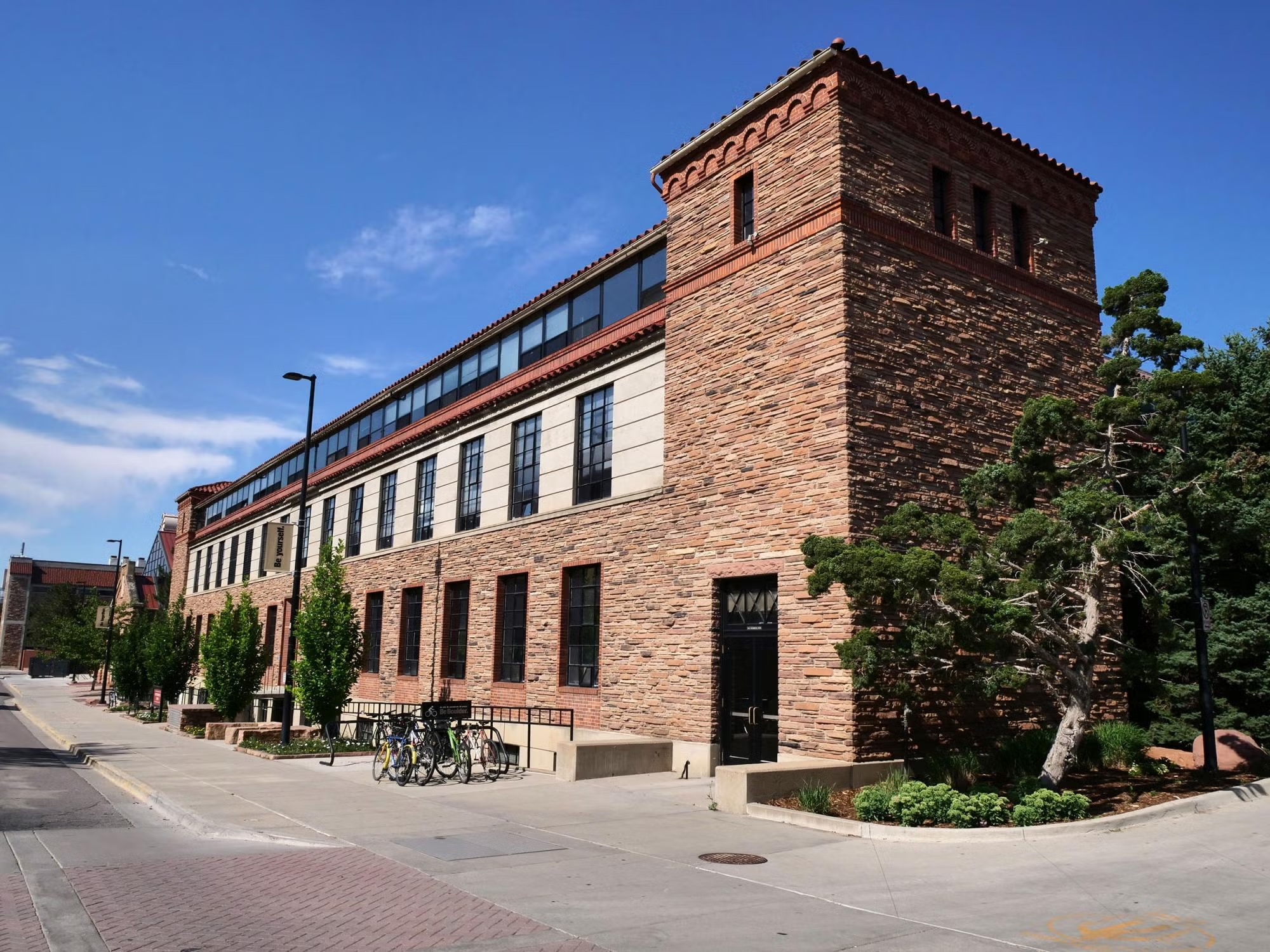
CU Boulder Environmental Design Building.
The CU School of Architecture was renamed the College of Environmental Design, and the 5-year BArch began phasing out in favor of the new 4-year BEnvd.
CU’s first graduate program, a Master of Urban Design (MUD), was delivered in 1969. It was located in the University of Colorado Denver Extension Center rather than in CU Boulder with the rest of the college. This was to give it in an urban setting.
CU Boulder launched their undergraduate degree program in environmental design in 1970.
In 1971, the new Master of Urban and Regional Planning (MURP) joined the MUD in the Denver Extension Center.
In 1972-73, the new Master of Architecture degree (M.Arch) joined the MUD and MURP in Denver. This was essential for the architects’ education, because in the 4+2 arrangement, NAAB only accredits the Master degree, not the BEnvd. The rationale for its location was to group the graduate programs together, and to be near the professional architecture firms in Denver.
CU Denver is officially established as a campus within the University of Colorado System.
The Extension Centers were formally split from CU Boulder in 1973 and renamed CU Denver and CU Colorado Springs as independent campuses within a University of Colorado System.
The Master of Landscape Architecture program was established at CU Denver.
In 1977, a new Master in Interior Design joined the other graduate programs delivered at CU Denver.
That same year, CU Denver, Metropolitan State University, and the Community College of Denver came together on a new shared campus downtown, the Auraria Higher Education Center, now known as the Auraria Campus.
The College of Environmental Design was renamed the College of Design and Planning with a School of Environmental design for undergraduate work at CU Boulder and a Graduate School of Design and Planning at CU Denver.
Managing one college on two administratively separate campuses increasingly challenged the programs. And over time, the Denver-based faculty gravitated more to professional interests while the Boulder based faculty continued to stress the interdisciplinary focus of the BEnvd.
To manage this more effectively, in 1981 the College of Environmental Design was renamed the College of Design and Planning, with two units: a School of Environmental design at CU Boulder for the undergraduate program, and a Graduate School of Design and Planning at CU Denver for the graduate programs. A resident dean in Boulder reported to the main dean in Denver.
Following a report from NAAB in 1985 during the Master of Architecture's re-accreditation year, concerns were expressed that the college's two campus arrangement was unsustainable. In May, the University of Colorado Board of Regents dissolved the College of Design and Planning and created two separate, independent entities—the School of Architecture and Planning in Denver and the College of Environmental Design in Boulder.
Following a report from NAAB during the Master of Architecture's re-accreditation year, concerns were expressed that the college's two campus design was unsustainable. In May, the University of Colorado Board of Regents dissolved the College of Design and Planning and created two separate, independent entities—the School of Architecture and Planning in Denver and Environmental Design in Boulder.
The Denver unit retained the graduate programs, while the Boulder unit retained the BEnvd. Each received its own dean reporting to its own campus.
The accreditation tied to the two-year MArch in Denver could no longer be maintained without an attached undergraduate degree, and was allowed to lapse. This left an accredited free-standing 3.5-year Master of Architecture, tailored for students with no previous undergraduate design education. Students with undergraduate design credits from any college including CU Boulder could receive advanced standing. The BEnvd in Boulder was no longer associated with an accredited professional degree.
In 1988, the CU Denver School of Architecture and Planning moved into the Dravo Building, now known as the CU Denver Building.
In 1989, the Center for Community Development and Design (CCDD) was renamed twice and moved out of the School of Architecture and Planning into the Denver campus’ central administration, where it was called the Colorado Center for Community Development (CCCD).
The Master of Interior Design was dropped in this period.
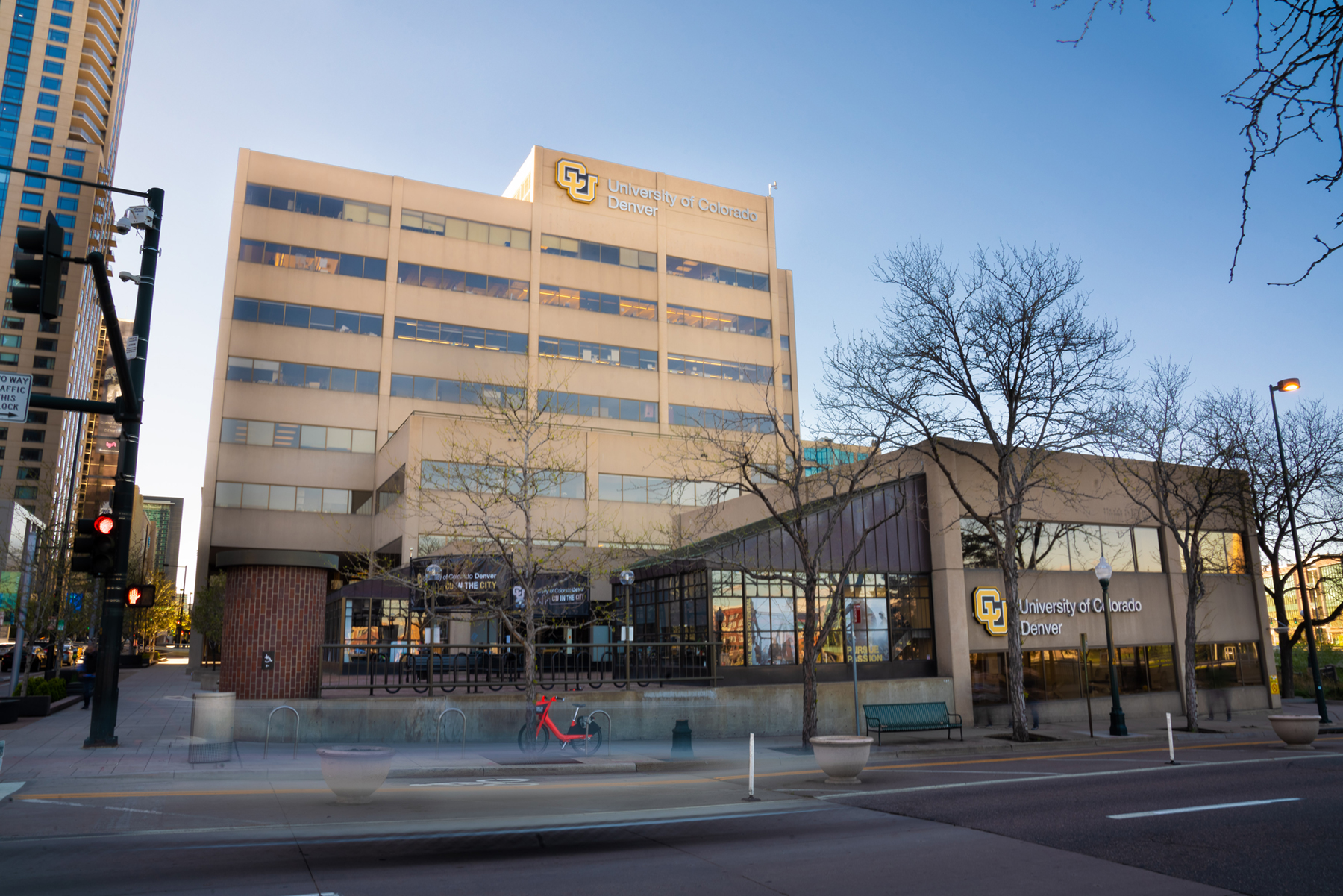
By 1992, the NAAB, both campuses, and the professional community agreed that separating undergraduate and graduate architecture onto separate campuses was not working well. The Regents merged the Denver and Boulder units into a new College of Architecture and Planning, now belonging to CU Denver but still delivering the graduate degrees in Denver and the undergraduate degree in Boulder.
The college faculty unanimously agree to organize into three departments in 1996—the Department of Architecture, the Department of Planning and Design, and the Program in Landscape Architecture.
The college ran a one day workshop at Union Station in Denver, called Kids in the City. This brought together faculty, design professionals and children from local neighborhoods, to design together improvements for their communities. This greatly strengthened the college’s ties to the city and to the professional offices.
A College Research Program in Western Lands, Resources and Development provided grants for faculty engaging in some of the challenges arising from rapid urban growth and pressures on rural lands in the West.
The college established its PhD program in 1997, delivered on the CU Denver campus.
In 1998, the Landscape Architecture department created Learning Landscapes, a service learning program in which graduate students designed innovative playgrounds for local schools. Money raised on the designs then allowed professional landscape firms to construct the projects. This led to a formal partnership between the college and the Denver Public School System in 1999 to create new playgrounds throughout the district.
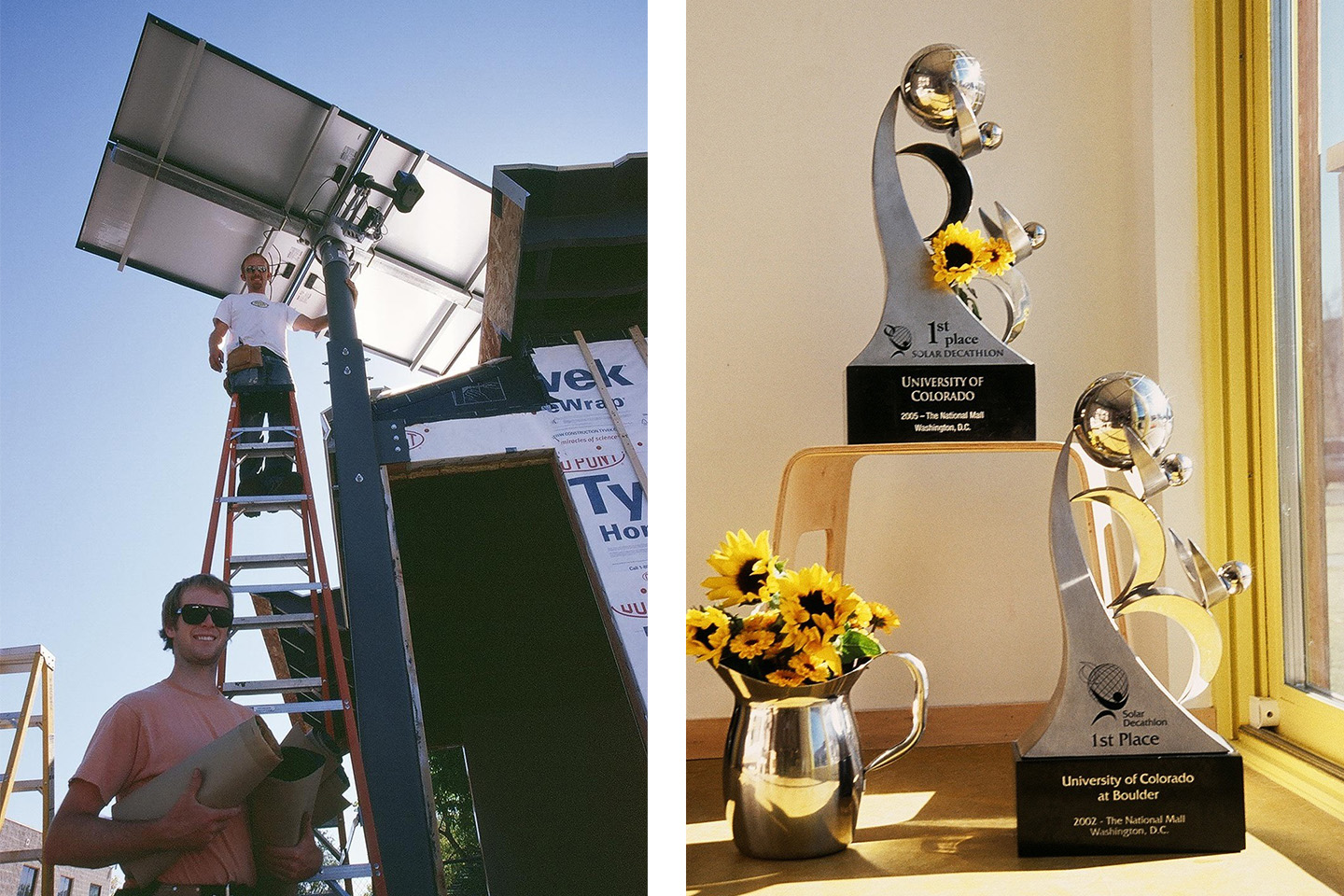
In 2002, in collaboration with Architectural Engineering in Boulder, the undergraduate CU architecture students won the first-ever national Solar Decathlon sponsored by the US Department of Energy. Entering the competition in 2005 without Architectural Engineering, they won again.
Also in 2002, the Colorado Center for Community Development (CCCD) was returned to the college from the Denver campus central administration.
The college established three new research centers based on faculty expertise and collaborations across departments: Children, Youth and the Environment (CYE); the Colorado Center for Sustainable Urbanism (CCSU); and the Colorado Center for Preservation Research (CCPR), later named the Center of Preservation Research (CoPR). See 20 years of the work of CoPR here.
In 2004, the CU Regents merged downtown CU Denver with the CU Denver Anschutz Health Sciences Center located on Colorado Boulevard. Anschutz subsequently moved to a new campus in Aurora.
The two were encouraged to collaborate. Landscape Architecture formed a partnership with the School of Medicine to study how playground design could affect physical and mental health. The obtained a multi-million dollar grant for a multi-year study from the National Institute of Health.
From the 1980s on, faculty from several departments had engaged students in design/build projects in Denver and throughout Colorado. The pace quickened after the Solar Decathlon wins, and Landscape Architecture students participated in design/build projects in New Orleans in 2006 after Hurricane Katrina.
In 2008, the college established the ColoradoBuildingWorkshop and implemented a design/build certificate. See almost two decades-worth of ColoradoBuildingWorkshop projects.
To support design/build and digital technologies for the undergraduates in Boulder, the college built wood and metal shops and a digital lab in CU Boulder’s off-campus lab, called the Center for Innovation and Technology (CINC).
Faculty in several programs, both undergraduate and graduate, had long run study abroad programs for their students. More formal arrangements were made in 2009 for Landscape Architecture, which created a shared degree with Tongi University in Shanghai. In this period the college also formed a partnership with Dar al-Hekma College (now University) in Jeddah, one of the first private all-women’s colleges in Saudi Arabia. CU helped the Dar al-Hekma faculty develop a new BArch program, which enrolled its first students in 2011. Architecture students at CU and Dar al-Hekma subsequently collaborated by Zoom on shared projects.
The Master of Science in Historic Preservation (MSHP) at CU Denver was established in 2010, following on a Certificate in Historic Preservation shared with the CU Denver Department of History.
The 1992 reunification of the Denver and Boulder programs into one college could not fully overcome the challenges of delivering its programs on two administratively separate campuses. In 2011 the CU Regents accepted a report from the two campuses recommending splitting the two apart again.
Only this time, the Regents established an undergraduate architecture program on the Denver campus, putting undergraduate and graduate architecture together in the same location for the first time in the college’s history.
Denver retained all of the graduate programs as well as the name College of Architecture and Planning. Boulder retained the BEnvd, administered in a department that in 2015 joined CU Boulder’s College of Communication, Media, Design and Information.
In support of the now greatly expanded College in Denver, the CU Denver campus gave most of the CU Denver Building to the college, also investing in a massive remodel of the building in 2013. This finally provided facilities suitable in purpose and image for a design school. Most of the annex to the building was also given to the college, where large digital tools like CNC routers could supplement the extensive workshops elsewhere in the building.
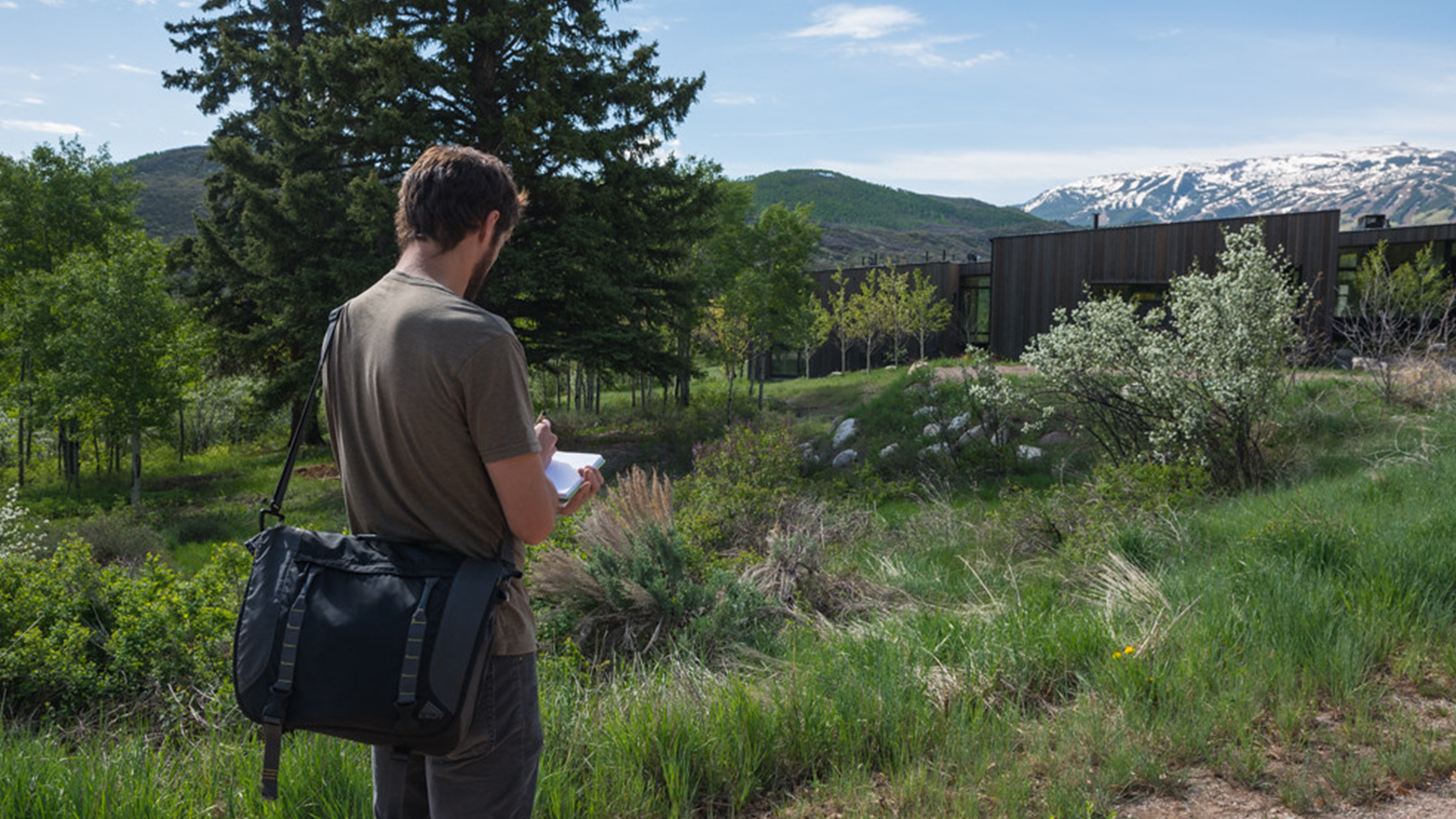
In 2011, the college created the Aspen Workshop , placing students in the offices of local architecture firms in Colorado's Roaring Fork region.
In 2013, the new Bachelor of Science in Architecture (BS Arch) admitted its first students.
In this period, a study abroad and student exchange program focused on Finland joined the other international initiatives.
The Department of Architecture created a Certificate in Classical Architecture, in partnership with the Institute of Classical Architecture and Art (ICAA) in New York. This was later supported with a new research center, the Center for Advanced Research in Traditional Architecture (CARTA).
In 2022, the College of Architecture and Planning Dana Crawford Preservation Program was named in honor of the legendary Dana Crawford, a trailblazer for historic preservation and urban revitalization in Colorado.
Also in 2022, the College of Architecture and Planning introduced a new graduate certificate and minor in interior design. The new courses of study further enhance CAP's encouragement of interdisciplinary study. View our graduate certificate programs and dual degree options.
In 2024, the Design/HEALth Initiative convened to improve design at every scale—from home to the biome—to enhance the health and wellbeing of all people and our planet.
The college introduced two new graduate certificate programs in 2025—a graduate certificate in affordable housing and a graduate certificate in climate and environmental justice.
The Affordable Housing Graduate Certificate is coordinated by faculty from the College of Architecture and Planning, the School of Public Affairs, and the College of Liberal Arts and Sciences. This interdisciplinary certificate is designed for current CU Denver graduate students and working professionals looking to develop specialized skills in the design, finance, policy, planning, and development of affordable housing.
The Climate and Environmental Justice Certificate is coordinated by faculty from CAP and the College of Liberal Arts and Sciences to provide current CU Denver graduate students and those with a BA or BS degree with the essential skills to integrate climate and environmental justice insights and practices into their professional career plans.
Currently, CAP offers the following graduate certificate programs:
View all graduate certificate program options.
Join us in celebrating 100 years of built environment education in Colorado!
From the first course in architectural engineering offered in the academic year, 1926-1927, to this academic year, 2026-2027, alumni, students, faculty, staff, friends, and partners of the built environment, let's come together to celebrate and look ahead toward the next 100 years.
This timeline is based Dean and Professor Emeritus Dr. Mark Gelernter's manuscript, A History of Education in Architecture and Related Disciplines in the University of Colorado.